



Why this matters for municipalities
Every municipality in Canada that builds or maintains asphalt roads relies on a binder specification, whether they wrote it themselves or adopted it from their provincial transportation agency. That specification determines what asphalt binder goes into the pavement, and the binder is the material that holds everything together. The binder is the glue, the waterproofing layer, and the component most sensitive to temperature, aging and traffic loading.
The challenge for municipal engineers is that binder specifications are not uniform across Canada, nor are they uniform across one province. Each province has developed its own approach, reflecting regional climate, local research, historical practice, and the priorities of the provincial agency that authored the standard. A municipality in Ontario is working under a different technical framework than one in New Brunswick or Alberta. The tests required, the aging protocols, the performance thresholds, and the supplementary requirements all vary.
This article maps that landscape. It is not a guide specification and does not recommend one provincial approach over another. Its purpose is to give municipal engineers a clear, side-by-side picture of what each province requires so they can understand what their own specification includes, what it does not, and where the broader Canadian practice is heading.
What is an asphalt binder specification?
An asphalt binder specification defines the material properties that liquid asphalt cement must meet before it is blended with aggregate to produce asphalt mix. It is a set of laboratory tests and pass/fail thresholds designed to ensure the binder will perform under the climate and traffic conditions the pavement will face.
In Canada, most binder specifications are built on one of two American Association of State Highway and Transportation Officials (AASHTO) frameworks:
AASHTO M 320 is the original performance-graded (PG) standard developed through the Strategic Highway Research Program (SHRP) in the 1990s. It grades binders by the high and low pavement temperatures they can withstand, expressed as a designation like PG 58-34: the binder is designed to perform at high temperatures up to 58°C and low temperatures down to -34°C.
AASHTO M 332 uses a newer test method called Multiple Stress Creep Recovery (MSCR) to evaluate how binders resist rutting. Rather than a single pass/fail value, it classifies binders into traffic loading tiers (Standard, Heavy, Very Heavy, and Extreme) based on how well they recover from repeated stress. This provides a more realistic picture of binder performance, particularly for polymer-modified binders under heavy traffic.
A third framework, penetration grading, predates the PG system entirely. It classifies binders by their consistency at 25°C using a needle penetration test and a viscosity measurement. While most of Canada has transitioned to performance grading, penetration grading is still in use in parts of the country.
Provincial specification overview: Grading systems
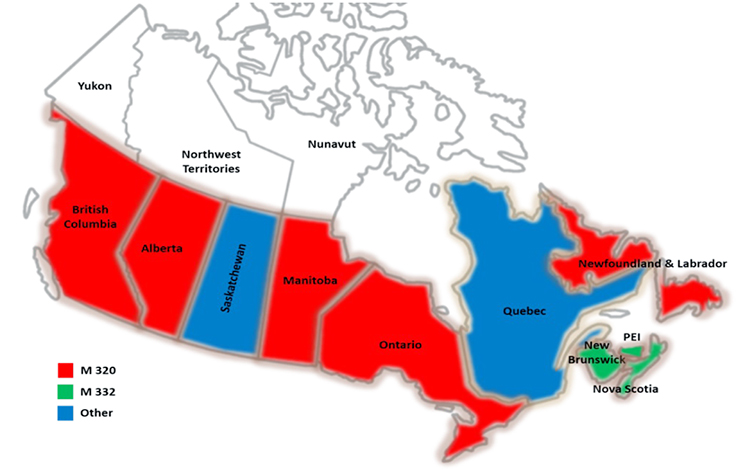
The first and most fundamental difference among provincial binder specifications is the grading system itself. Most provinces have converged on M 320 or M 332 as their base standard. Quebec operates under its own MTQ 4101 standard, which is closely aligned with M 332 in its use of MSCR testing, but it includes several requirements unique to the province. Saskatchewan uses penetration grading exclusively, and British Columbia and Manitoba maintain parallel PG and penetration-grade tables.
| Province | Base Standard |
| Alberta (AB) | M 320 |
| British Columbia (BC) | M 320 + pen |
| Manitoba (MB) | M 320 + pen |
| New Brunswick (NB) | M 332 |
| Newfoundland & Labrador (NL) | M 320 |
| Nova Scotia (NS) | M 332 |
| Ontario (ON) | M 320 |
| Prince Edward Island (PEI) | M 332 |
| Quebec (QC) | MTQ 4101 (PG) |
| Saskatchewan (SK) | Pen only |
Performance grade ranges by province
The range of PG grades available varies considerably. Alberta offers the widest span, from PG 46 (for extremely cold, low-traffic applications) to PG 76 (for high-temperature, heavy-traffic corridors). Most provinces cluster between PG 52 and PG 70. The low-temperature grades reflect each province’s climate exposure, with -34 and -40 being common across northern and central Canada.
| Prov. | Lowest High | Highest High | Coldest Low |
| AB | PG 46 | PG 76 | -40 |
| BC | PG 52 | PG 76 | -40 |
| MB | PG 58 | PG 58 | -40 |
| NB | PG 52 | PG 70 | flexible |
| NL | PG 52 | PG 70 | -40 |
| NS | PG 52 | PG 70 | flexible |
| ON | PG 52 | PG 70 | -40 |
| PEI | PG 52 | PG 70 | -28 |
| QC | PG 52 | PG 64 | -40 |
| SK | N/A (pen) | N/A (pen) | N/A |
Note: In New Brunswick and Nova Scotia, “flexible” means the low-temperature grade is selected for each project or region rather than fixed in the specification.
Aging protocol: PAV conditioning
The Pressure Aging Vessel (PAV) simulates the long-term aging that asphalt binder undergoes during its service life in a pavement. Nearly all provinces using PG use a standard 20-hour PAV at either 90°C or 100°C, after which the binder is tested for intermediate and low-temperature properties. Ontario and Quebec also collect data from 40-hour PAV conditioning, currently for informational purposes rather than as pass/fail requirements.
| Prov. | PAV20 | PAV20 Temperature | PAV40 |
| AB | Yes | 90°C (PG 46/52), 100°C others | No |
| BC | Yes | 100°C | No |
| MB | Yes | 100°C | No |
| NB | Yes | 100°C | No |
| NL | Yes | 90°C (PG 52), 100°C others | No |
| NS | Yes | 100°C | No |
| ON | Yes | 90°C (PG 52), 100°C others | Informational |
| PEI | Yes | 100°C | No |
| QC | Yes | 90°C (soft grades), 100°C others | Informational |
| SK | No | N/A | No |
MSCR and high-temperature rutting resistance
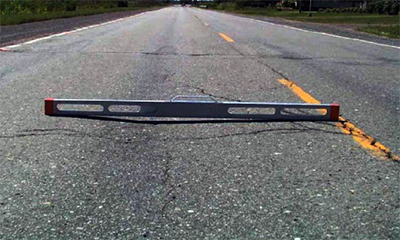
Most Canadian provinces now include some form of MSCR testing in their binder specifications, either as part of the base standard (as in M 332) or as a supplementary requirement added on top of M 320. The test repeatedly loads and unloads a binder sample, first at a low stress of 0.1 kPa and then at a higher stress of 3.2 kPa, and measures how much it deforms permanently (non-recoverable creep compliance, or Jnr) and how much it recovers (percent recovery, or R) at each stress level. Specifications are written around the 3.2 kPa results, Jnr, 3.2 and R3.2, because the higher stress better represents heavy traffic and separates binders, particularly polymer-modified ones, more clearly than the low stress does. A lower Jnr, 3.2 means less rutting potential; a higher R3.2 means more elastic recovery. Some provinces also limit how much the Jnr value is allowed to increase between the two stress levels, expressed as a percentage difference (Jnr, Diff). Provinces that cap Jnr, Diff at 75% are requiring consistent behavior under both stress levels. How provinces apply these three measures varies considerably.
| Prov. | Jnr, 3.2 Limit | R3.2 Recovery | Jnr, Diff |
| AB | No | Yes | No |
| BC | No | Yes | No |
| MB | No | PMA only | No |
| NB | Yes (by tier) | No | 75% max |
| NL | No | No | No |
| NS | Yes (by tier) | No | 75% max |
| ON | Yes (<4.50) | Formula | Info only |
| PEI | Yes (by tier) | No | 75% max |
| QC | Yes (by tier) | Formula | 75% max |
| SK | N/A | N/A | N/A |
The three Atlantic M 332 provinces (New Brunswick, Nova Scotia, PEI) and Quebec use traffic loading tiers (see table below) that set progressively tighter Jnr, 3.2 limits based on the severity of the loading application. Ontario takes a different approach where a maximum Jnr, 3.2 limit of 4.50 kPa-1 is set across all grades, combined with a formula-based recovery requirement.
Ontario’s formula-based R3.2 requirement takes a different approach to elastic recovery. Rather than a fixed pass/fail value, Ontario requires that R3.2 meet or exceed the lesser of 55% or [(29.371)(Jnr, 3.2)-0.263]. Quebec has adopted a parallel formula-based approach. This creates a continuous performance relationship between creep and recovery, rather than a set of fixed tiers.
M 332 traffic loading tiers
| Tier | Jnr, 3.2 Limit (kPa-1) | Application |
| n = S (Standard) | ≤ 4.50 | Low or standard traffic loading |
| n = H (Heavy) | ≤ 2.00 | Heavy truck routes |
| n = V (Very Heavy) | ≤ 1.00 | Very heavy or slow-moving traffic |
| n = E (Extreme) | ≤ 0.50 | Extreme loading (standing loads) |
| n = U (Ultra, Quebec only) | ≤ 0.15 | Quebec-exclusive ultra-stiff tier |
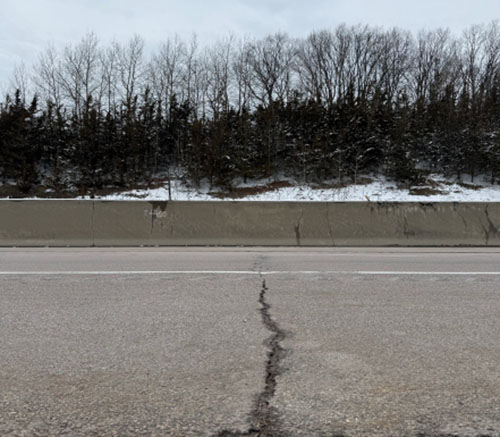
Transverse thermal crack propagating across full lane width, a classic stress-fracture response to extreme low-temperature conditions.
Low-temperature cracking resistance
Low-temperature cracking resistance is universally important in Canada, yet the test methods used to evaluate it vary considerably across provinces. The Bending Beam Rheometer (BBR) creep stiffness test is the common baseline across all PG provinces. Beyond that, the landscape diverges.
Alberta and Manitoba are the only provinces that require Direct Tension testing, which measures whether the binder can stretch without breaking at cold temperatures beyond just measuring its stiffness. Quebec takes a different approach: it requires a critical low-temperature (Tb) verification. The standard BBR test checks whether a binder passes at the nominal grade temperature, but it does not determine the actual temperature at which the binder will crack. A binder designated -34°C might actually crack at -35°C or at -32°C, and the standard test would not distinguish between the two. Quebec’s Tb verification determines the actual cracking temperature and confirms it meets or exceeds the nominal grade, rather than accepting the designation at face value.
Ontario’s low-temperature framework includes two tests not currently used in other provinces. In addition to the standard BBR test, Ontario requires a fracture toughness test, Critical Crack Tip Opening Displacement (CTOD), that measures how resistant the binder is to cracking, once a crack has started to form. It also requires a Low Temperature Limiting Grade (LTLG) determination, which accounts for a phenomenon called physical hardening. When asphalt binder sits at cold temperatures over time, it continues to stiffen beyond what the standard BBR test measures after one hour of conditioning. The LTLG test conditions samples for extended periods at cold temperatures to determine how much the binder’s low-temperature grade shifts as the stiffening progresses. Ontario limits how far the grade is allowed to shift, which means a binder graded to -34°C must still perform close to that temperature even after extended cold exposure, not just at the moment of initial testing.
The Delta Tc (ΔTc) parameter targets cracking behavior that is affected by asphalt binder durability related to aging of the binder in an asphalt mixture. More specifically, ΔTc provides insight into the relaxation properties of a binder that can contribute to non-load related cracking or other age-related embrittlement distresses in an asphalt pavement. Block cracking is the most common distress of this type.
ΔTc captures the difference between BBR-derived critical temperatures for stiffness and relaxation. Both Ontario and Quebec currently collect ΔTc data for informational purposes.
| Prov. | BBR | Direct Tension | Critical Tb | CTOD | LTLG | ΔTc |
| AB | Yes | Yes | No | No | No | No |
| BC | Yes | No | No | No | No | No |
| MB | Yes | Yes | No | No | No | No |
| NB | Yes | No | No | No | No | No |
| NL | Yes | No | No | No | No | No |
| NS | Yes | No | No | No | No | No |
| ON | Yes | No | No | Yes | Yes | Info only |
| PEI | Yes | No | No | No | No | No |
| QC | Yes | No | Yes | No | No | Reported |
| SK | No | No | No | No | No | No |
Why understanding these differences matters
The specifications described in this article differ in their details, but they are all trying to solve the same fundamental problem: ensuring that the asphalt binder in the pavement will resist rutting in summer, resist cracking in winter, and hold up under traffic and aging over the life of the road. The differences reflect how each province has chosen to measure and verify that performance.
For a municipal engineer, the value is not in memorizing test names or threshold values. It is in understanding that every binder specification tests for some performance risks and not others. Knowing what your specification covers, and what it does not, is what puts you in a position to make informed decisions about your roads.
That is the purpose of this article series. Each article that follows will take one aspect of binder performance, explain what it means for pavement life, and show how Canadian provinces are addressing it in their specifications. The goal is to give you the foundation to evaluate your own specification with confidence, not to replace it, but to understand what it is doing and why.
Coming next
This article is the big picture. The articles that follow in this series will go deeper into individual binder parameters: what each test measures, the research that produced it, the pavement distress it is designed to address, and what it means in practical terms for a municipal engineer writing or evaluating a specification.
The next article in the series, From climate to grade: How temperature data shapes your binder specification, will explain how high and low temperature grades are determined from climate data, how MSCR traffic tiers add a loading dimension to the grade and why getting the grade right is the foundation every other specification decision builds on.
Contact Amma Agbedor.