


In 1992, the U.S. government released a food pyramid intended to provide guidance to millions on how to make healthier choices. At the base of the pyramid was the recommendation to consume large quantities of grains (6-11 servings per day), while protein and fats from meats and dairy were placed near the top, signaling they should be minimized. For many Americans, this pyramid served as a trusted framework for healthy eating, so they followed it and felt good about prioritizing their health.
A couple of decades later, in 2014, the comedy show “South Park” aired an episode in which citizens of the town were panicked as gluten (found in grains) was portrayed as a highly toxic substance in the food. Scientists were clueless in how to deal with the crisis until one of the main characters, Cartman, called into a USDA hotline and claimed to know how to safely consume gluten and resolve the emergency – he suggested that we had the pyramid upside down all along and just needed to flip it. Once the pyramid was flipped, grains were now minimized, protein and fats were now prioritized, and the problem was resolved once and for all.
Scientists went on to instruct the president to simply carry on and “have some steak with your butter!” Crisis averted. This was all just for fun and to have a good laugh, right? Well, fast-forward to January 2026 when the revised USDA food pyramid was released and it represents nearly the inverse of that original guidance and the satirical plot from “South Park” has now become a reality.
This significant reversal raises important questions about how guidelines are developed and updated and how industries and individuals can better ensure that foundational decisions reflect the best available evidence.
I, like many Americans, certainly had a nice laugh when the new food pyramid was released as we recalled the earlier South Park episode. Then, the laughs stopped and reality set in – is the new advice on making food choices really the opposite of the prior advice? How do those who followed the previous advice for decades feel about that? Angry? Scammed? How is this even possible? Experts in charge of creating guidelines used by millions of people need to be able to get closer to the correct answer than that, right? I would certainly hope so.
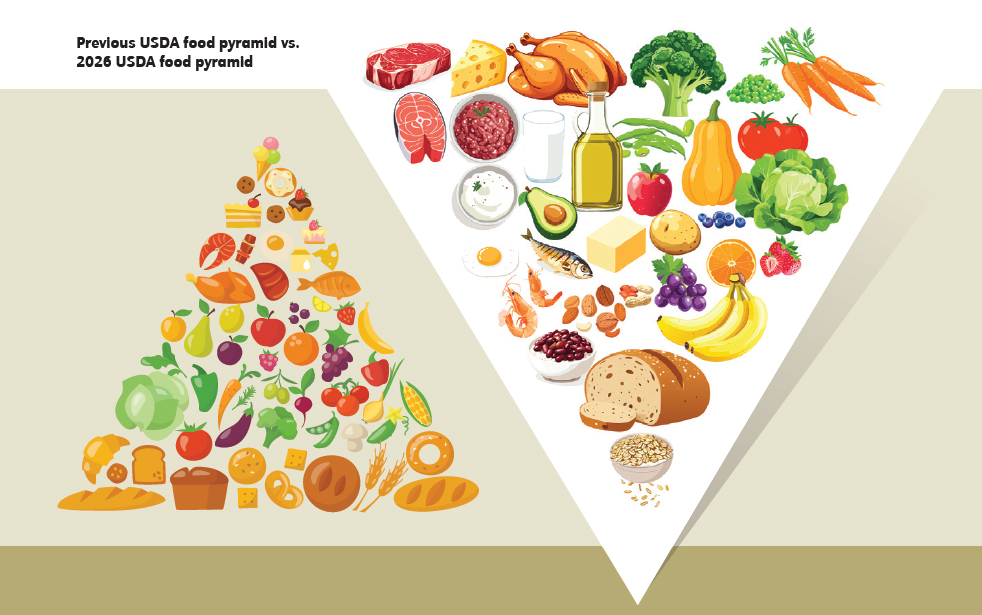
Let this serve as a cautionary tale that we may be better off educating ourselves and asking probing questions than deferring uncritically to established guidelines. As bizarre as this all sounds, it is 100% true, and it made me examine whether something like this may be happening in the asphalt industry as well. So, let’s take a look.
If I were to attempt to create a pyramid describing how asphalt pavements are presently designed, specified, built and maintained with main priority given to the items at the bottom (base) of the pyramid and minimal consideration given to items nearer to the top of the pyramid, it would probably look like the following:
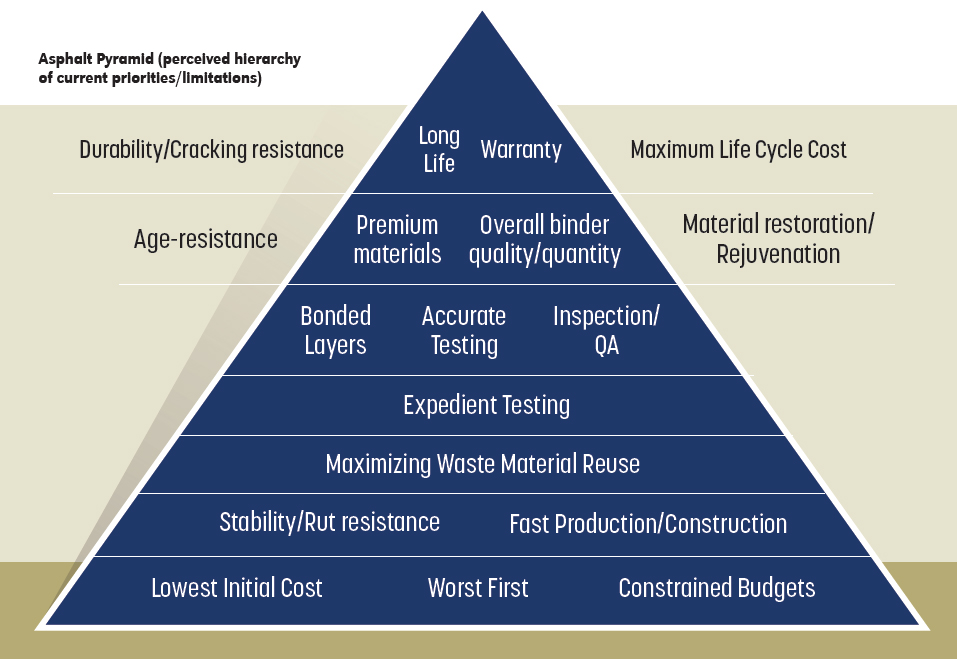
I could spend a lot of time discussing each of these points, but I will attempt to touch on each just briefly and explain why I believe the asphalt pyramid may literally be upside down – just like the food pyramid.
Let’s discuss some of the asphalt pavement priorities in the U.S. Aside from a few less standard cases, such as toll roads, public private partnerships (PPPs) and other private infrastructure investments, the idea of constructing an asphalt pavement with the longest possible lifespan at the lowest life cycle cost is mostly a foreign idea. Shocking, right!? It obviously should not be that way. Asphalt pavements in the U.S. are prioritized based on what I’d like to describe as “worst first” and “low bid.” The analogy I often like to use to describe “worst first” is if a brand-new vehicle was purchased, and the owner refused to ever change the oil in it, what would happen? This approach would obviously lead to premature failure and the lowest possible lifespan of the vehicle. However, if you are only focused on the near-term, you would save a few bucks by skipping the oil change, right? Then, that failed vehicle would need to be replaced, resulting in massive overspending for a replacement vehicle, because the previous one should have lasted much longer. It may even lead to getting a cheaper vehicle next time due to a constrained budget. I use this example, because it is easy to see the irony in it. Less obvious is the fact that this is often how asphalt pavements are purchased and maintained. We often ignore them until they are perceived to be in the “worst” possible condition, in which case the pavements are selected for rehabilitation using a limited budget. This approach is driven by lack of funds while having to address public safety through stopgap/emergency rehabilitation and repairs.
Making matters worse, construction is typically driven not only by the lowest initial cost, but also by the fastest production pace, since time is money and users dislike delays. A far better approach to make the best asphalt pavements is to prioritize those in good-to-moderate condition for maintenance and ensure they are built with the highest quality materials at the lowest life cycle cost.
Let’s tackle another issue – the importance of bonded layers and how inspection/QA are key to achieving good bond and good overall asphalt construction. During the early part of my career, I was responsible for pavement structural design, and one thing I later learned once I moved to the materials/construction side of asphalt is that the structural designers rarely communicate with the materials/construction folks. This often leads to assumptions in design that are not even close to what is happening in the field.
One example is poor interlayer bonding (assumed to be fully bonded in design). Loss of bond is often attributed to insufficient quantity of residual tack coat material, non-uniform coverage, or tracking of the tack coat layer. The latter can be caused by a dirty surface, insufficient tack coat curing, selecting the wrong tack coat or failing to maintain the integrity of the tack coat, among other issues. I’ve even seen specifications with the perfect language to address all these issues, but with little or no inspection/QA to enforce the specifications, what good is the language? The bottom line is that the design only works if the asphalt is constructed according to the design assumptions, and more often than not, this isn’t the case when it comes to interlayer bonding of asphalt pavements (a survey of DOTs in 2018 revealed that tracking is still an issue about 60% of the time). These items should receive higher priority in our asphalt pyramid.
Another key issue is that our mix designs and materials selection processes are not effectively balancing rutting resistance (stability) and cracking resistance (durability). We have overly compensated for stability to such an extreme degree that durability is basically an afterthought, as shown in the pyramid. This is probably because rutting often happens very early in the pavement life before asphalt begins aging whereas cracking tends to occur later in the pavement life after aging. Therefore, rutting failures are deemed to be the bigger problem to avoid. However, mix designs are supposed to be about “balance.” The balance is meant to give equal consideration to rutting and cracking distresses so that materials are selected and mixtures are designed with both stability and durability in mind. This is simply not what is happening in practice, so our pyramid hierarchy of priorities must be corrected in this regard.
Certain states that have experimented with adding additional binder, which improves durability, have been surprised at just how much additional binder can be added with no adverse effects to stability. This can only mean stability and durability were initially far out of balance in mix design. Rather than focusing on a cracking test for “balance,” perhaps adding more binder until getting closer to the rutting limit would be a more effective approach for balancing stability and durability in mix design.
With respect to the effects of binder quality on durability, it has been known for several years now that the standard method of simulating long-term lab aging of PG asphalt binders using the PAV is largely insufficient. This means virgin binders are not actually tested for long-term aging resistance (7-10 years in service) as previously intended, and this step is required to ensure the binders perform against cracking long-term
Further, most mixtures now also contain a maximum allowable amount of waste material reuse, reclaimed asphalt shingles (RAS), which is less common, or reclaimed asphalt pavement (RAP) (20%± or so on average), both of which replace not only virgin aggregates with recycled aggregates but also replaces ductile virgin binder with brittle/aged, recycled binder. The RAP binder is typically not even tested for quality or resistance to cracking according to our PG binder testing protocols. This means the virgin binder isn’t tested for long-term aging resistance, and the RAP binder isn’t generally tested at all for cracking resistance.
Not to mention, the stiff binder from RAP is now understood to be only partially activated during the mixing process, meaning most mixtures containing RAP are “dry.” This is where implementing recycled binder availability (RBA) and additional binder can substantially improve durability. In summary, these mixtures contain diminished quality of binder and lack sufficient total effective binder needed for good “balance” and good mixture durability. Stability, which improves with stiffness is overly prioritized at the expense of durability as depicted in the pyramid.
Methods such as rejuvenation (another aspect of our pyramid) will improve the quality and activation (availability) of the RAP binder (allowing us to responsibly increase its usage) but implementing rejuvenation may slow the production process and/ or add to the initial materials costs, and therefore rejuvenation hasn’t been widely adopted despite its obvious benefits. This just doesn’t fit with the low-bid/ fast-production base elements of the pyramid.
A related variable appearing on our pyramid and receiving a tremendous amount of vetting in our industry is the selection of a mixture cracking test – one capable of predicting the cracking performance of the asphalt while in service, potentially leading to bypassing binder testing, material specifications, and even conventional mixture designs altogether. Such a test would certainly be a “Holy Grail” for our industry, unleashing unprecedented innovation, expedited processes, elimination of recipe specifications, and perhaps amazing performance predictability. The only issue is that efforts to produce the accurate test have been short-circuited by efforts to produce a different kind of test – the expedient test.
The ability to accurately predict the cracking performance of asphalt in service requires carefully selecting not only a good and accurate test but also appropriate conditioning of the specimens when tested (such as long-term aging) and consideration of time and temperature, including dwell/lag time, which may impact the results of such testing. The accurate test may not be an expedient test and often will not be. While researchers continue trying to understand these important issues, the answer I hear most often when asking stakeholders about which test our industry is most likely to select in the end – the answer is the cheapest, easiest, and most convenient test that doesn’t significantly disturb the elements listed in the base of the pyramid. Just imagine if we selected a test that prioritized the elements at the top of the pyramid, instead. This may topple the whole thing and literally flip it on its head. Maybe we are onto something.
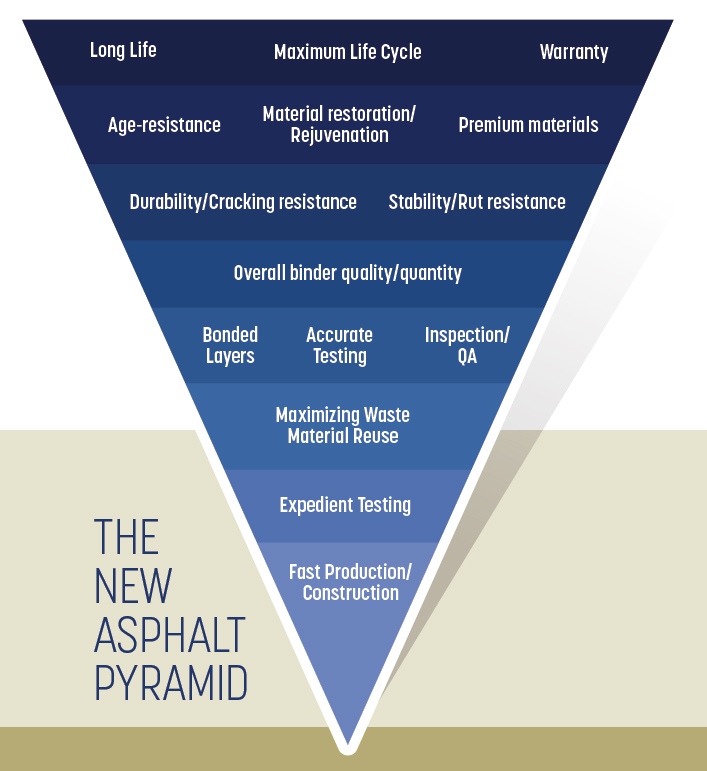
Based on these observations and after feeling a bit “cheated” by the current perceived asphalt pyramid, I offer the “new asphalt pyramid,” which is nearly the opposite of our current practices as shown below.
Although constrained budgets, low bid, and “worst first” are legitimate cost considerations affecting how asphalt pavements are designed and built, these factors should have no impact on guidelines for designing and building the best asphalt pavements possible any more than a food pyramid should be selected based on cost factors related to food products. Just tell me what is best, and I’ll decide how to spend my money. These guidelines lead to optimization, and if we can’t afford to follow them due to up-front costs, we will certainly pay an even bigger price in the long run – this is inevitably true for both food and asphalt! In closing, if Cartman can inspire a new USDA food pyramid, adoption of the new asphalt pyramid may not be such a stretch.
Allen is an Asphalt Institute Regional Engineer based in Florida.