



“The value of a test report is only as great as the quality of the test data.”
This mantra (or a similar one) is often repeated by engineers, researchers and laboratory managers within the scientific community. It is no less true for those who work in the field of asphalt science: quality asphalt research and test reporting are dependent upon quality testing results.
Data is constantly flowing between private industry, public agencies and other institutions that make key decisions related to asphalt production, acceptance, research and innovation. This complex data web can be as intricate and interwoven as the asphalt pavement itself, with the final product dependent on the quality of the materials and actors at each step in the process. And while the quality of the data may come down to a myriad of factors, it ultimately falls to the asphalt technician as the key player impacting data validity and reliability.
The scientific aspect of asphalt laboratory testing is self-evident. Proficient technicians will have a solid grasp of the underlying scientific concepts related to the data they are generating. Rather than simply pressing a button and turning in a data report, they will have an enhanced understanding of what the data means, allowing them to identify errors and biases at an early stage. Knowledge and adherence to testing methodology will inevitably foster accurate and repeatable data.
But while the science of asphalt laboratory work is critical, it must be acknowledged that the work of the technician is also an art form. Laboratory technique is equally essential to the technician as studio technique is to the artist painting on a canvas. Experience through repetition and observation is paramount; it is the experienced technician who will not only understand what the data means, but who will be able to see the story that the data is telling. Artists are formed not simply through acquiring knowledge, but by combining knowledge and technical skill to produce something of value.
If asphalt technicians are both scientists and artists, then it becomes necessary to ensure they are not only drawing from the same technical principles but also painting with the same paintbrush. This is where professional certification plays a vital role in the asphalt testing industry. Through the dual lens of knowledge and skill mastery, certified asphalt technicians can ensure that the data they are generating is an item of value wherever it may be used. Simply put, certification is the mechanism by which science and art are brought together to ensure data quality industry-wide.
The SCIENCE of certification
The Performance-Grade (PG) asphalt specifications prevalent today in the United States were not constructed on a whim; they were carefully crafted using broad datasets built on fundamental engineering concepts. Understanding those concepts is a priority for technicians who wish to validate the quality of the data they are generating. Through increased knowledge, an errant test result may be identified before it ever makes it to a test report. Likewise, a greater understanding of data will illuminate trends that may be key to identifying instrument failure or bias. Armed with the appropriate knowledge and tools, prepared technicians can not only identify problems in the lab but can also take the appropriate steps to remedy the issue.
For example, consider a laboratory technician who sees that the complex shear modulus (G*) values for asphalt binder tested on the Dynamic Shear Rheometer (DSR) in their laboratory are consistently high when compared to other laboratories. A knowledgeable technician will know that test temperature is highly influential on binder stiffness and will quickly verify that the DSR temperature controls are working properly and make the appropriate changes if necessary. In this case, both knowledge of temperature effects on binder stiffness and understanding of how to properly standardize the equipment are ensuring data quality.
This type of technical knowledge can be evaluated and measured through a written testing format. Technicians who are familiar with test methods and specifications will be able to apply those learned concepts through basic data assessment, identification of data trends and implementation of appropriate steps to promote precision. By passing a nationally standardized exam, a certified technician is demonstrating sufficient understanding of testing concepts, such that assurance of quality data is increased.
The ART of Certification
During the 16th century, Europe experienced an artistic explosion with the creation of paintings, sculptures and architecture that encompass the extent of most of the general public’s familiarity with art history. A distinct development was made during this time; the switch from tempera to oil as a painting medium. With this change, paint dried more slowly – allowing the artist more time to blend the rich, reflective colors for more realistic renderings. Perhaps more impressive than the visual evolution emerging from this switch was the quick and widespread adoption of the new technique by the Florentine artists – the best of their craft. Being a Florentine artist in 1510 A.D. carried weight, respect and responsibility. Their willingness to readily embrace a new medium was a guidepost for all artists. The history of this serves as an archetype for craft progress at large.
Artists communicated, trained and practiced with their peers, fostering a culture of competition, mastery and trade development. They understood innately that the overall success and influence of their industry relied on their willingness to innovate and, share that innovation.
Consequently, the spirit of an artist resides in workers across many diverse practices over 700 years later, including that of an asphalt technician. Much likes artists, nationally certified technicians are precise, confident, analytical and curious. The process of attaining certification challenges technicians to refine their craft as well as their understanding of industry concepts, all while sharing that knowledge with others in their field.
Upon stepping into a certification review day, you might hear the following dialogue, “Do you trim with a rounded, angled or hooked tool?”, “Clockwise or counter?”, “Try cradling the spindle with a paper towel to prevent excess drips.” This example is the epitome of knowledge transference; individuals sharing their expertise with one another so that information is not only transferred to the student but also strengthened and reinforced within the educator. Additionally, it illustrates a materializing personal style in lab practices. While standards set the scientific precedent for accurate and reliable data, the development of a nuanced style and creative problem-solving coalesce to form a technician with high self-efficacy and intrinsic motivation for their work.
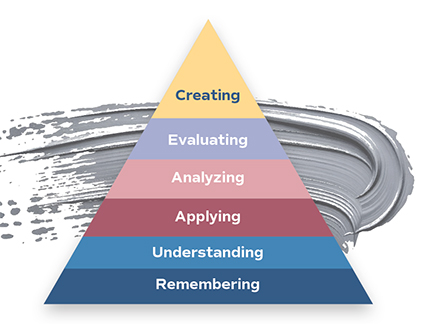
The idea of this is presented in Bloom’s Taxonomy, an educational theory that presents one’s depth of understanding on a given concept as a pyramid where one “stage” provides a foundation and scaffolds the next level of knowledge expression. Atop the pyramid sits “create”, in other words, when a technician can use their knowledge to create their own systems or help to train others, they are demonstrating true mastery. National certification presents ample opportunities for this peer-to-peer learning to occur on a wider perspective for technicians involved, versus regionally shared information.
Furthermore, an artist observes in a holistic manner. While each data point and technique is important and tells a story on its own, the artist-technician notices patterns and sees the entirety of the picture being presented. The culmination of these skills is evaluated in lab certification programs during the practical exam section. In the case of PG asphalt binder certification, technicians are required to conduct a live demonstration of their efficiency and effectiveness in DSR and BBR testing, both of which demand a high level of technical refinement. Passing the practical exam erases any self-doubt within a technician and reaffirms that their skills are recognized in a meaningful way.
The through line that presents itself is that dedicated technicians, like artists, will rise to the occasion when a challenge or innovation is presented. And through that rise, they will gain confidence, assist others, seek the highest level of standards, and grow the industry as a whole. Attaining certification empowers the technician and conveys to others that they are capable and accomplished.
The SCIENTIST and the ARTIST
Having a cohesive, national program that incorporates both the science and the art of asphalt testing is essential for promoting data quality, decreasing variability and minimizing user-producer disputes. The best technicians are not only the ones who understand the data they are generating (science) but who also have committed themselves to refining their laboratory techniques (art). Both science and art are critical to data quality.
For asphalt binder testing, the Asphalt Institute’s National Binder Technician Certification (NBTC) program captures both of these elements on a national scale. In cooperation with the Northeast Transportation Training and Certification Program (NETTCP), the NBTC program provides the infrastructure for asphalt binder technicians across all ranks of the construction sector (users, producers, independent laboratories and other institutions) to ensure that all actors are reading from the same script. Certification candidates not only have the opportunity to demonstrate their scientific understanding through passing a written exam, but they must also pass a practical exam that reflects their technical skill. Importantly, those attending the course at the Asphalt Institute headquarters in Lexington are exposed to respected asphalt professionals who can help them embrace and grow in the science and art of asphalt testing, while gleaning other key nuances of their field through interacting with their peers.
Quality data depends on quality technicians. Through national certification, technicians positively impact the quality of the asphalt industry by confirming their understanding and technique. As the asphalt landscape changes, having certified asphalt technicians who are operating toward a common goal of quality pavements will continue to ensure that the industry moves forward.
Cooper is the Asphalt Institute Lab Manager and Research Scientist. Durham is an Asphalt Binder Technician.