



Your pavement failed
Your test didn’t see it coming
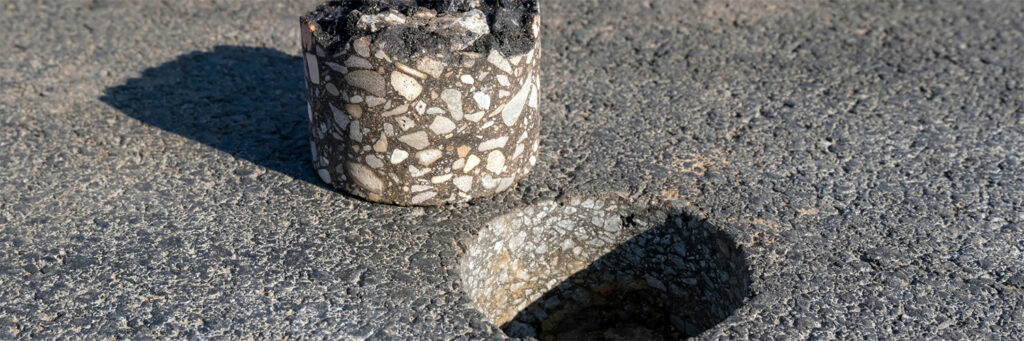
Pull a core from a three-year-old pavement and find it falling apart in your hands, that is not how a pavement designed for 15-plus years of service is supposed to behave.
That is exactly what the Pennsylvania Turnpike Commission (PTC) found when they investigated premature rutting on a recently reconstructed section. Here is the part that should give every agency pause: 20 years before that core was pulled, the National Center for Asphalt Technology (NCAT) had already documented moisture damage on that same section of pavement. [1] At the time, NCAT found that water was infiltrating the pavement structure through joints and cracks, saturating the underlying layers and rupturing the bond between asphalt binder and aggregate. Stripping had already progressed through multiple pavement layers before it surfaced as visible distress. AASHTO T283, the freeze-thaw tensile strength ratio test that measures a mix’s resistance to moisture-induced damage, was recommended as the appropriate tool to screen mixes for moisture susceptibility going forward.
Fast-forward 20 years and T283 has been the industry’s primary moisture damage screening test. The mix placed on that PTC road had passed T283. It contained the required chemical anti-strip. Every box was checked.
It still failed.
Over two years, the PTC pulled 1,600 additional cores from across their network. Seventy percent showed severe moisture damage. Failed material totaled over five million tons, a replacement bill estimated at $3.5 billion. The question that followed was not simply why the pavement had failed. It was why the tests had not predicted it.
A test with a known problem
AASHTO T283 remains the default moisture damage screen across most agency specifications in North America. Its limitations are not new information. Research published through NCHRP has documented that mixtures performing well in the field have, in some instances, exhibited unexpectedly low TSR values, while poor-performing mixtures have, in some instances, returned unexpectedly high ones.[2] One reason cited consistently is that the moisture conditioning in T283 does not simulate actual field conditions. [2] In a study supported by the Ohio DOT (ODOT), researchers evaluated multiple moisture susceptibility test methods and found that TSR results did not reliably correlate with field performance, noting that detachment of binder from aggregate was not even visible on T283 specimens despite observed field distress. They also found that the correlation between contractor-tested and ODOT-tested TSR results for the same mix was low, raising additional concerns about reproducibility. Their recommendation was to discontinue the use of T283 for moisture susceptibility determination altogether and transition to the Hamburg Wheel-Track Test.[3]
PTC’s experience adds a specific and significant data point to the concerns about moisture susceptibility testing. They ran a blind collaborative Hamburg study, where specimens were prepared with material from failed sections, and were tested in three independent labs without disclosure of which samples contained anti-strip additive. The specimens tested with the Hamburg wheel tracker produced no stripping inflection point and no meaningful rut depth difference between treated and untreated samples. Both tests missed the failure mode entirely.
Standard moisture damage test procedures require distilled water, free of contamination. That is a reasonable starting point for a controlled laboratory environment, but PTC reasoned that it does not reflect what pavements actually encounter in service. Road surfaces are exposed to runoff and groundwater, and in cold-weather climates there can be months of concentrated deicing brine. The question PTC began asking was whether the chemistry of that water, particularly its pH and sodium concentration, could be playing a role that current test methods were never designed to detect.
What PTC found when they looked at water chemistry
PTC’s internal forensics led them to a straightforward but consequential hypothesis: could outside influences, specifically water pH and winter deicer chemistry, be degrading anti-strip protection in ways that standard testing would never detect?
To test this, they modified ASTM D3625, the standard boil test, with a pre-soak step. Coarse aggregate samples coated with binder and anti-strip additive were soaked for 72 hours in a sodium bicarbonate solution adjusted to a minimum pH of 8.3, then subjected to the standard boil procedure. Mass loss before and after provides a quantitative binder retention figure. This modified procedure, which the PTC now calls the Extended Boil Test, was the first method across all their testing that produced lab results visually and quantitatively matching what they were finding in field cores.[4]
A follow-up study replaced the alkaline soak with 100% sodium brine, increasing the soak duration to 160 hours. Results were comparable, roughly 2.7 grams of binder lost versus 3.0 grams in the alkaline soak. Whether the primary damaging mechanism is pH, sodium concentration, or a combination of both remains an open research question. What the PTC’s data suggests is that both conditions, alkaline water and sodium-rich brine, can compromise anti-strip protection in ways that neither T283 nor Hamburg would identify.[4]
The PTC has since applied the Extended Boil Test to approximately 200 plant-produced samples from their network. Thirty-eight percent showed significant binder loss, a figure that points to a systemic gap between what laboratory screening captures and what pavements experience in service.[5]
A practical tool for agencies
The Extended Boil Test is not yet an AASHTO or ASTM procedure. It is an agency-developed protocol, with minimal equipment requirements: a pH meter, food-grade sodium bicarbonate, a hot plate and a balance. As a screening and diagnostic tool, it directly addresses the variable that standard methods exclude, real-world water chemistry, without requiring specialized equipment or significant laboratory investment.
The PTC’s position is that the test has merit as a vetting tool for anti-strip products and as a quality control check on plant-produced material. It is not presented as a replacement for T283 or Hamburg in a specification context, but as a practical complement that asks a question current methods do not: how does this material perform when the water isn’t distilled?
Why this traveled north
Brian Paroda’s “Via Bitume” article caught the attention of Canadian practitioners when it was published in August 2025. That visibility led to an invitation to present the PTC’s forensic analysis work to the Transportation Association of Canada’s Soils and Materials Committee. The reception was immediate, and the reason is straightforward. Road surfaces in most Canadian provinces are exposed to sodium chloride and magnesium chloride deicers for three to four months of the year. Freeze-thaw cycling is more frequent and more severe than in Pennsylvania. Alkalinity contributions from concrete substrates are common wherever asphalt overlays existing concrete.
The PTC’s pavements had passed every required test. When they pulled the cores, the results told a different story. It is worth asking whether the same gap exists in your network.
References
[1] Kandhal, P.S. & Rickards, I.J. (2001). Premature Failure of Asphalt Overlays from Stripping: Case Histories. NCAT Report 01-01. National Center for Asphalt Technology, Auburn University.
[2] National Academies of Sciences, Engineering, and Medicine. (2010). NCHRP Web-Only Document 166: Precision Estimates of AASHTO T283: Resistance of Compacted Hot-Mix Asphalt (HMA) to Moisture-Induced Damage. Transportation Research Board.
[3] Green, R., Rodezno, C., Robbins, M. & Oklu, J. (2023). Identification of Enhanced Moisture Susceptibility Testing for Asphalt Pavements. FHWA/OH-2023-19. Ohio Research Institute for Transportation and the Environment, prepared for Ohio Department of Transportation.
[4] Paroda, B. (2025). Field Performance of Amine-Based Anti-Strips and Development of a Practical Test Model. Via Bitume, August 2025, pp. 34–39.
[5] Paroda, B. (2026). Moisture Damage – A Persistent Elusive Foe. Presentation to the Transportation Association of Canada Annual Conference, Soils and Materials Committee.