



From promise to practice
In a previous article, high polymer-modified (HP) asphalt binders and mixtures were introduced through a fundamental question facing the pavement community: should these materials be used to design thinner pavement structures or to extend pavement service life? That discussion highlighted the potential of HP technologies and the range of strategies available to agencies, but it also revealed a broader challenge, namely the limited consistency in how these materials are defined, specified and implemented across the industry.
At that time, it was noted that the Asphalt Institute, in collaboration with the Virginia Transportation Research Council (VTRC), was leading an effort to conduct a comprehensive gap analysis on the use of HP binders and mixtures. This work was carried out as part of a cooperative agreement on the Development and Deployment of Innovative Asphalt Pavement Technologies between the Federal Highway Administration (FHWA) and the University of Nevada, Reno (UNR), in collaboration with the Asphalt Institute, National Center for Asphalt Technology (NCAT), VTRC, Asphalt Testing Solutions and Engineering (ATSE) and other partners.
Through a comprehensive effort that included a literature review, agency engagement and evaluation of field practices, the study aimed to document current practices, identify key gaps and synthesize lessons learned from state Departments of Transportation (DOTs) actively using HP binders and mixtures. In addition, a SWOT (strengths, weaknesses, opportunities and threats) analysis was conducted to further evaluate implementation challenges and identify areas for improvement. The intent of this article is to summarize the key findings of that effort.
A glimpse into the state of knowledge
A substantial body of literature has documented the benefits of HP binders and mixtures, including several publications that provide detailed reviews of laboratory and field performance. More recent studies conducted between 2018 and 2024 have continued to reaffirm these findings, showing that HP materials improve resistance to rutting, fatigue and reflective cracking and raveling, while also offering potential structural benefits such as reduced pavement thickness.
Recent applications have expanded across a range of conditions, including thin overlays, high-stress locations and interlayers, demonstrating their versatility in practice. However, despite these advancements, much of the available data remains based on pilot projects and short- to mid-term evaluations, highlighting the need for broader field validation and long-term performance assessment. Building on this understanding, the following section examines how these materials are being implemented in practice.
A snapshot of the state of practice in the U.S.
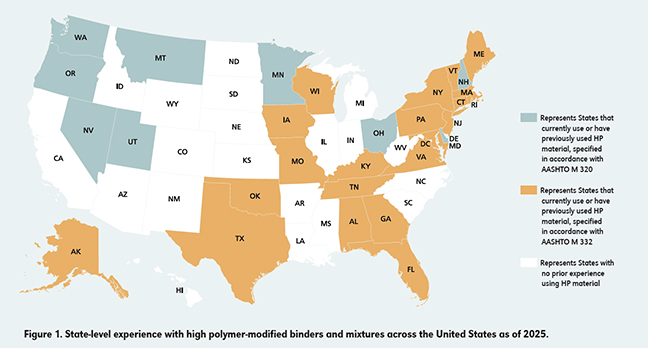
A 2021 study by VTRC showed that 21 U.S. state DOTs had experience with HP materials and highlighted a shift toward defining these binders based on performance characteristics such as elasticity and recovery rather than polymer content. More recent efforts indicate that this state of practice continues to expand. A broader review of specifications, field projects, and agency engagement now identifies approximately 30 state DOTs with experience using HP binders (refer to Figure 1). While specifications vary, most agencies rely on performance-based criteria, often using AASHTO M 320 or M 332, with an emphasis on elastic recovery and overall resistance to rutting. Overall, these findings reflect a growing and more structured adoption of HP technologies across the U.S.
While these findings highlight the growing adoption of HP technologies, a closer look at individual state DOT practices provides valuable insight into how these materials are being specified, designed, and constructed in real-world applications.
One example of this implementation comes from the FHWA’s Every Day Counts initiative on Targeted Overlay Pavement Solutions (TOPS), which highlighted the Florida DOT’s (FDOT) experience with HP binders and mixtures. These materials were used in high-stress locations to mitigate rutting, cracking, and raveling, with research and field performance confirming improved durability compared to conventional polymer-modified asphalt (PMA), along with the potential for reduced pavement thickness.
By 2021, FDOT had placed more than 500,000 tons of HP mixtures across multiple applications, demonstrating that these materials can be successfully produced and constructed using conventional practices with proper controls. While initial concerns related to cost and constructability were noted, field experience and performance have supported their continued use.
Building on these findings, this study incorporated direct engagement with five state DOTs: New Jersey, Ohio, Oklahoma, Utah and Virginia. These agencies represent a range of conditions and practices, providing valuable insight into how HP binders and mixtures are currently implemented in the field.
State DOT experiences with HP mixtures
While national trends provide a useful overview, the practical application of HP materials is best understood through the experiences of individual agencies. The following highlights key observations from five state DOTs actively implementing HP binders and mixtures.
New Jersey DOT (NJDOT)
NJDOT has more than 18 years of experience with HP binders and mixtures, primarily in bridge deck waterproofing surface courses and ultra-high-performance thin overlays. The agency has also explored highly modified binders in chip seal applications (e.g., PG 88- 22FR and PG 94-22) to improve aggregate retention and skid resistance under demanding traffic conditions.
NJDOT follows a performance-based approach, focusing on binder rheology and mixture performance rather than polymer content. HP mixtures have demonstrated improved durability, particularly in rutting and reflective cracking resistance, although they are not currently assigned additional structural design credit. Ongoing efforts focus on refining specifications, improving testing efficiency, and expanding use in preservation strategies.
For readers interested in additional details on New Jersey’s efforts, the state memorandum is available here.
Ohio DOT
Ohio DOT uses HP mixtures in bridge deck waterproofing and high-stress locations, with growing interest in applications such as perpetual pavements, interlayers, and thinner overlays. HP binders are specified as pre-blended materials meeting PG 88- 22M requirements and are evaluated based on elastic recovery, separation resistance, and workability.
Mixtures are designed using Superpave or Marshall methods, with no reclaimed asphalt pavement (RAP) permitted and no additional structural credit assigned. Research efforts have shown improved rutting resistance and potential service life extension, though at higher initial cost. HP mixtures are produced and placed using conventional practices, and Ohio DOT continues to evaluate their long-term performance and cost-effectiveness.
For readers interested in additional details on Ohio’s efforts, the state memorandum is available here.
Oklahoma DOT
Oklahoma DOT has over a decade of experience with HP mixtures, primarily in rich intermediate layers for structural and rehabilitation applications. These mixtures have been effective in improving rutting resistance and mitigating cracking, especially under heavy traffic or weaker subgrade conditions.
HP binders are defined using MSCR-based performance criteria, with emphasis on recovery and creep compliance (MSCR denotes multiple stress creep and recovery). Mixtures are designed using Superpave and evaluated using the Hamburg Wheel- Track Test, with no RAP permitted and no additional structural credit assigned. Field experience indicates that HP mixtures can be produced and placed using conventional practices, with ongoing interest in their use for full-depth and perpetual pavement applications.
For readers interested in additional details on Oklahoma’s efforts, the state memorandum is available here.
Utah DOT (UDOT)
UDOT has more than nine years of experience with HP binders and mixtures, though early efforts revealed challenges with binder-only substitution, in which conventional modified binders were replaced with higher polymer-content binders without corresponding adjustments to mixture design or composition. Those lessons led UDOT to develop a specialized Highly Modified Asphalt mixture known as HiMod. These HiMod mixtures are designed with low air voids and high in-place densities and up to 15% RAP, by mass. HiMod mixes are the first surface mixtures which allow for the incorporation of RAP in Utah. They are validated through performance testing.
These mixtures have been successfully used in overlays, interlayers, and structural applications, including rehabilitation of concrete pavements, with some projects demonstrating significant cost savings. While currently treated similarly to conventional mixtures in structural design, UDOT continues to evaluate their enhanced structural contribution through ongoing field research projects.
For readers interested in additional details on Utah’s efforts, the state memorandum is available here.
Virginia DOT (VDOT)
VDOT has used HP mixtures since 2014, primarily in overlays to improve crack resistance and durability on jointed concrete and high-volume roadways. HP binders are specified based on performance requirements in accordance with AASHTO M 332, with strict quality control at both terminal and plant levels.
Mixtures are designed using conventional volumetric approaches, with RAP limited and no additional structural credit assigned. Field experience and research have demonstrated improved resistance to reflective cracking and extended service life. VDOT continues to apply HP mixtures selectively while evaluating their long-term performance and broader implementation potential.
For readers interested in additional details on Virginia’s efforts, the state memorandum is available here.
Usage and cost trends of HP mixtures
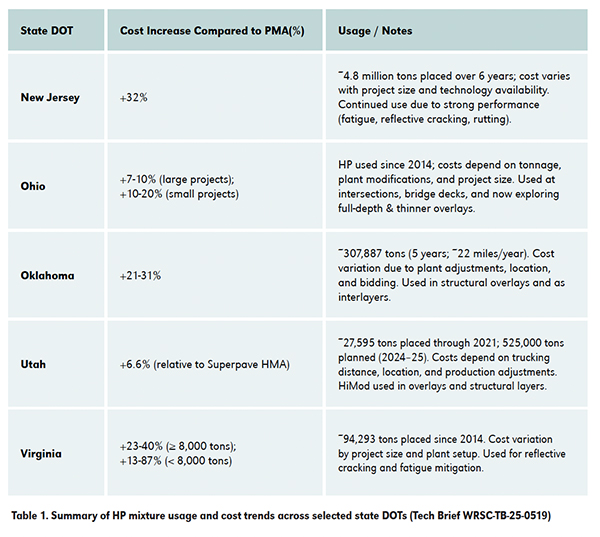
Across the five state DOTs, the use of HP mixtures has grown steadily, with applications ranging from targeted high-stress locations to broader paving programs. Reported usage varies significantly by agency, reflecting differences in program scope, experience, and level of adoption. While HP mixtures consistently carry a higher initial cost compared to conventional PMA mixtures, the magnitude of this premium varies widely depending on project size, production volumes, and plant requirements.
Despite these higher costs, all agencies continue to use HP mixtures due to their demonstrated performance benefits, particularly in improving resistance to rutting and cracking and, in some cases, enabling thinner pavement structures. Although formal life-cycle cost analyses are limited, agencies generally consider HP mixtures a cost-effective solution for extending pavement service life and reducing maintenance needs, especially in high-stress and high-importance applications.
A summary of usage levels and cost ranges across the five agencies, reflecting the state of practice as of August 2024, is presented in Table 1.
Implementing HP technology: state experiences
The implementation of HP binders and mixtures across state DOTs has generally followed an incremental and experience-driven approach rather than a formal, statewide rollout. Most agencies began with pilot projects, often in high-stress locations, and expanded usage based on observed field performance and growing confidence in the technology.
Across the five states, adoption was shaped by a combination of research partnerships, peer exchange and practical considerations such as cost, constructability and plant capabilities. Some agencies incorporated control sections to evaluate performance, while others relied on comparisons with adjacent conventional pavements. In all cases, implementation evolved through iterative refinement of specifications and construction practices.
Overall, these experiences highlight that successful adoption of HP materials depends on gradual integration, strong collaboration between stakeholders and continuous evaluation of field performance to support broader implementation.
Key lessons and ongoing challenges
Experience across multiple state DOTs shows that HP mixtures can generally be produced and constructed using conventional practices. However, fully realizing their benefits often requires adjustments in mix design, particularly targeting lower air voids and higher in-place densities. Agencies have also emphasized the importance of proper binder handling, storage considerations, and the need for acceptance tests that better capture the behavior of highly modified binders.
Several challenges remain: most notably higher initial costs, limited supplier availability and handling constraints associated with shorter binder shelf life. Additional barriers include industry hesitation to adopt new specifications and the lack of structural design credit for HP mixtures.
To address these challenges, agencies have adopted practical strategies such as limiting binder storage time, strengthening supplier and contractor coordination, and enhancing quality control practices. Across all states, clear communication among stakeholders has emerged as a critical factor for successful implementation.
Despite continued progress, key gaps remain, including limited long-term performance data, the absence of life-cycle cost analyses, and incomplete integration of HP materials into mechanistic pavement design frameworks. Addressing these gaps will be essential to support broader and more confident adoption of HP technologies.
A strategic look at HP mixtures
The adoption of HP binders and mixtures across state DOTs reflects a balance between demonstrated performance benefits and practical implementation challenges. To capture this balance, a SWOT analysis was conducted based on specifications, literature, and direct engagement with agencies.
Strengths
HP mixtures consistently demonstrate enhanced rutting resistance, improved fatigue performance, and increased overall durability compared to conventional materials. These benefits are supported by field performance, research findings and continued engagement from agencies, industry and FHWA, providing a strong foundation for broader implementation.
People
FHWA Pavement & Materials Program: Support and commitment from FHWA, aiding in research, implementation, and policy development.
State DOTs: Recognition of HP binders’ benefits by select DOTs, with implementation showing improved long-term performance.
Industry and Research Community: Engagement from asphalt industry leaders, researchers, and academia to advance HP binder technologies and implementation.
HP Technology
Enhanced Performance: Enhanced rutting resistance, improved fatigue life, and increased durability compared to conventional binders.
Compatibility with Existing Design Methods: Can be integrated into mechanistic-empirical pavement design frameworks.
Advancements in Binder Modification: Continuous improvements in polymer chemistry, binder formulation, and performance testing enhance reliability.
Weaknesses
Key challenges remain, including the lack of a unified definition for HP binders, which has led to variability in specifications and expectations across agencies. A related issue is the interchangeable use of nomenclatures such as HiMA, HP, HiMod, HPG and HIMOD mixtures, which, although often associated with improved performance, represent distinct materials or systems with different intents and characteristics.
For example, HiMA is a trademarked binder technology, while HP is a broader, performance-based designation adopted by several state DOTs (e.g., FDOT, VDOT) and organizations (e.g., Asphalt Institute). Utah’s HiMod framework extends beyond binder modification to emphasize mixture design and compaction targets, whereas HPG refers to a high-performance grading approach used in certain regions like Texas. High-modulus mixtures (HIMOD), developed in Europe, focus on stiffness and structural capacity rather than solely binder modification. This lack of consistent terminology can create confusion in specification development, communication, and implementation.
Additional limitations include higher initial costs, variability in contractor familiarity, and technical considerations related to binder storage stability, workability, and mixture optimization.
People
Variability in Expertise: Differences in experience levels among DOTs, contractors, and researchers can lead to inconsistent implementation.
Limited Contractor Familiarity: May require specialized handling, mixing, and placement techniques, which may not be widely understood.
HP Technology
Lack of Standardized Definition: The absence of a formal definition for HP binders and mixtures among state DOTs creates inconsistencies in specifications and performance expectations.
Higher Initial Cost: Increased material costs compared to conventional asphalt binders may limit widespread adoption.
Specification Variability: Lack of standardized definitions and performance-based specifications across different agencies.
Potential Workability Concerns: Higher polymer content may impact mixture compaction and field performance.
Optimization Challenges: Issues related to polymer dosage, aggregate compatibility, tank storage stability, shelf life, and long-term durability in varying environmental conditions.
Opportunities
Growing emphasis on durable, high-performing pavements presents clear opportunities for expanded use of HP technologies. Advancements in performance testing, increased collaboration among agencies, and the development of long-term field data can help improve consistency, quantify benefits, and support broader adoption.
Federal and State Funding Support: Increased focus on longer-lasting infrastructure may drive investment in HP technologies.
Growing Demand for High-Performing Pavements: Aligns with agencies’ goals and performance-driven specifications.
Advancements in Testing and Characterization: Improved testing methods can help optimize HP binder selection and usage.
Collaboration and Knowledge Sharing: Potential for multi-state research initiatives, pooled fund studies, and industry partnerships to refine best practices.
Field Performance: Longer-term performance information from experienced states may support quantification of benefits.
Threats
Potential barriers include supply chain constraints, limited supplier capacity, and the need for specialized infrastructure to handle highly modified binders. Higher upfront costs, workforce training needs, and competing funding priorities may also limit adoption if not adequately addressed.
Supply Chain and Material Availability: Limited production capacity for high polymer-modified binders may create procurement challenges.
Budget Constraints: Higher upfront costs may deter state DOTs with limited funding.
Workforce Training Needs: Adoption may require additional training for engineers, inspectors, and contractors to ensure proper field implementation.
State Priorities: Potential changes in infrastructure policies or funding priorities could impact adoption rates.
Overall, the SWOT analysis highlights both the potential and the challenges of HP materials, emphasizing the need for continued refinement, collaboration and strategic implementation.
Path forward
The study synthesized current practices, specifications, and agency experiences with HP binders and mixtures, supported by a structured SWOT assessment. Overall, the findings confirm that HP technologies can significantly enhance rutting resistance, cracking performance, and long-term durability, and when properly implemented, may support thinner and more efficient pavement designs.
Despite these benefits, broader adoption remains constrained by higher initial costs, variability in specifications, supply chain considerations, and the lack of a unified, performance-based definition. Agencies that have achieved the greatest success have approached HP materials as part of an integrated system, combining binder selection with optimized mixture design and appropriate performance evaluation.
Moving forward, continued progress will depend on advancing performance-based specifications, expanding long-term field validation and improving consistency in terminology and implementation practices. Strengthening collaboration among agencies, industry and research organizations will be critical to translating promising results into scalable solutions.
While HP technologies are not a universal solution, they represent a valuable tool for improving pavement performance and extending service life when applied strategically. Future efforts should also broaden engagement across the supply chain and explore opportunities related to polymer optimization, sustainability and integration with recycled materials.
Habbouche is an Asphalt Institute Regional Engineer based in Arizona. Johnson is an Asphalt Institute Regional Engineer based in Montana.
For readers interested in additional details, the full technical brief documenting this effort is available here.