


Almost twenty years of this work across Canadian climate zones, and seriously, this winter has given me more to document than most. Every weather watch, snowstorm warning, deep freeze warning… it obviously got me thinking about how it would impact our road infrastructure.
In late January 2026, a polar vortex pushed wind chill values in northern Quebec to between -45°C and -50°C, while southern Ontario sat at a sustained -35°C feel through the same weekend. A few weeks earlier, in late December 2025, Montreal got freezing rain, a brief thaw, then a hard drop back to -13°C feeling like -24°C, a full thaw-refreeze cycle inside 24 hours. That kind of thermal whiplash matters, and I’ll come back to why.
What makes this winter worth examining closely is how differently it unfolded across the country, and in some cases, how far the actual conditions diverged from what was predicted. Going into winter the 2025-26 season, forecasters were calling for milder-than-average conditions across the Prairies, and broadly speaking, that held up. What it didn’t account for was what milder actually means for pavement. More time spent near zero, crossing the freezing mark repeatedly, is in some ways harder on asphalt than sustained deep cold. Edmonton’s own city report, released in March 2026, attributed lagging pothole repair performance directly to more precipitation and frequent freeze-thaw cycles through the last few months of 2025. Realization: A milder forecast and a damaging winter are not mutually exclusive.
Meanwhile, on British Columbia’s Coquihalla Highway, there were reports of maintenance crews fixing the same potholes fifty to sixty times this winter, with some craters reaching (ready?) the size of a small bathtub by January 2026. Ontario and Quebec were different stories again. Unlike a typical southern Ontario winter, where a thaw usually follows a major snowfall within a few days, the cold this season was… just different. The long-range forecast for mid-February was still calling for below-normal temperatures. The snow sat, and the ground stayed frozen.
The data out of Atlantic Canada is also worth noting. Between January 1 and February 2, 2026, Halifax logged 737 pothole repair requests. The same period last year: 118. That’s six times the volume, same road network, one different winter.
Two mechanisms worth separating out
Two things are happening out there this winter. They’re related but they’re not the same, and understanding the difference is half the battle.
Threat 1 – Thermal cracking at extreme low pressures
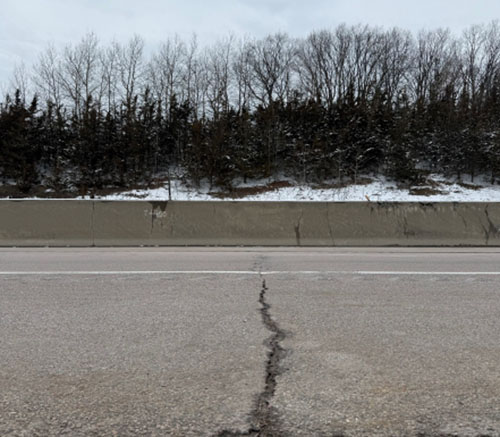
That crack in the photo isn’t fatigue damage, it’s not reflection, it’s not ravelling. It’s the pavement telling you it got too cold, too fast, and the binder couldn’t hold on. As temperatures drop, the binder contracts faster than the aggregate around it. That tension builds until something gives, and what gives is a clean transverse crack, full lane width, fairly evenly spaced. The older the pavement, the more oxidized the binder, the less it takes to get there.
This is where the Superpave Performance Grading (PG) system is supposed to come in. PG grades aren’t based on air temperature, they’re based on pavement temperature, and pavement temperatures run colder than the air. So, when Ontario and Quebec were sitting at -30°C to -40°C this January, the pavement surface was operating colder still. On a newer road with a well-specified binder, there’s some buffer built in. On a road that’s been in service for fifteen or twenty years, that buffer is largely spent because the binder has oxidized, it’s stiffer than its original grade, and it doesn’t take much to crack it.
The research backs this up on two counts: cooling rate matters, and binder age matters. The roads that have been most impacted this winter aren’t the ones that were poorly built. They’re the ones that have simply been out there long enough that the binder isn’t what it was at the time of design. Once those cracks open, water finds its way in. And that’s a different problem entirely.
Threat 2 – Freeze-thaw cycling and accelerated deterioration
In Montreal, Environment Canada recorded at least 17 freeze-thaw days in January 2026 alone. Each one of those is a discrete damage event. Water works its way into an existing crack or void, freezes and expands, opens things up a little further, then thaws, leaving behind a slightly larger pathway for the next infiltration. It’s a slow process, and then it isn’t.
The numbers from this winter aren’t subtle.
| MONTRÉAL 3,824 Pothole complaints Jan 1–27, 2026 ≈ 5× prior year | TORONTO 1,194 Pothole damage claims to late Feb 2026 ≈ 2× prior year | HALIFAX 737 Repair requests Jan 1 – Feb 2, 2026, 6× same period 2025 |
Alberta’s Chinook effect is worth calling out because with temperature swings of up to 30°C in a matter of hours… that can make for some of the most aggressive single-event freeze-thaw cycles in the country. The damage looks different from Ontario’s but it’s no less real.
BC tells a similar story through different numbers. Coquihalla Highway crews were patching the same holes fifty to sixty times this winter, with some reaching the size of a small bathtub by January. The temperatures aren’t as extreme as central Canada, but the cycling is relentless. The pavement doesn’t care which way you get there.
Where things stand
Most of the damage is already in the pavement. Spring just makes it visible.
What this winter gave Canada, from British Columbia to Atlantic Canada, is something a normal winter wouldn’t: a real cross-country picture of how our pavements respond when the thermal environment stops cooperating. Alberta surprised us. BC wore crews down. Central Canada took it from both sides. Atlantic Canada had a completely different winter than the one twelve months before. That’s not noise. That’s data.
I’ll be watching the spring maintenance numbers.
This article was generated with research assistance from Claude and Notebook LM and has been composed, reviewed and edited by humans.
References
[1] CBC News, “From Alberta to the Atlantic provinces, Canada faces a wind-chilled deep freeze,” Jan. 24, 2026. cbc.ca/news/canada/canada-cold-weather-9.7058988
[2] CBC News, “Frigid temps to ring in the new year in Eastern Canada,” Dec. 30, 2025. cbc.ca/news/canada/freezing-rain-ontario-quebec-maritimes-9.7029882
[3] Rocky Mountain Outlook, “The 2025-26 Alberta Winter Forecast,” Nov. 1, 2025.
[4] CBC News, “Winter storm buries Eastern Canada in snow,” Jan. 26, 2026. cbc.ca/news/canada/snow-storm-canada-9.7060874
[5] CBC News, “Bumpy ride for Halifax-area drivers as pothole reports increase sixfold,” Feb. 4, 2026. cbc.ca/news/canada/nova-scotia/halifax-pothole-reports-up-in-2026-compared-to-2025-9.7073971
[6] Büchner et al., “Requirements for the low-temperature cracking resistance of asphalt binders,” Road Materials and Pavement Design, 2025.
[7] Xie, H., “Refining Superpave Asphalt Binder Characterization,” Asphalt Magazine.
[8] MnDOT, “Test Methods to Quantify Cracking Resistance of Asphalt Binders and Mixtures,” 2021.
[9] Ground News / Winnipeg Free Press, “Montreal Faces Increased Potholes Amid Winter Freeze-Thaw,” Feb. 17, 2026.
[10] CBC News, “Toronto sees rise in pothole damage claims as winter continues,” Feb. 25, 2026. cbc.ca/news/canada/toronto/toronto-potholes-damage-9.7106085
[11] CBC News, “Cold, warm, then cold again: Montreal’s unseasonable weather takes a toll,” cbc.ca
[12] CBC News, “Edmonton pothole repairs and snow clearing fall short of city targets,” Mar. 13, 2026. cbc.ca/news/canada/edmonton/edmonton-pothole-repairs-snow-clearing-targets-9.7126776
[13] Living in Canada, “The Climate and Weather of Calgary, Alberta.” livingin-canada.com
[14] CBC News, “Potholes the size of a small bathtub on B.C.’s Coquihalla Highway,” Jan. 17, 2026. cbc.ca/news/canada/british-columbia/potholes-coquihalla-highway-9.7049469