


An exploration of Kentucky rock asphalt
Millions of years before a University of Kentucky basketball player scored a basket or anyone mixed bourbon into a mint julep at the Kentucky Derby, nature was creating something remarkable. In south-central Kentucky, nature slowly formed an estimated 500 million tons of Kentucky rock asphalt. It was once well known and widely used, but over time it slipped from memory. Today, only historians and a few locals still talk about it, even though this unique Kentucky resource is still right here.
What is rock asphalt?
Simply, it is porous rock impregnated with asphalt or bitumen, as it is called outside the U.S. Like other deposits of asphalts discovered worldwide, Kentucky rock asphalt (KRA) is natural, requiring no refinery or intervention by humans at all to exist. It was formed over millennia by Earth’s processes, and it was quarried, crushed and softened with steam or dry heat, placed and compacted as a pavement from the late 19th century until 1957. In 1824, the first modern road paved with natural rock asphalt was the Champs-Élysées in Paris, France dispensing with bricks and cobblestone. The resource has a fascinating history from the formation of KRA to its rise as the world’s once-leading paving material. How was it formed?
Plants to pavement
Asphalt is a ‘fraction’ of crude petroleum, the portion left after other fractions are removed through natural or artificial processes. It is the fraction usually left after the rest dissipates into the atmosphere if left alone, or produced in a refinery where the rest is collected to be used as other products. Its origins were once alive – algae, plankton, bacteria and animals.
But how do the lives of countless organisms ultimately result in a pavement? What are the stops along the journey to becoming petroleum and, finally, Kentucky rock asphalt:
Marine snow
Over millennia, the remains of plants and animals filter to the bottom of the oceans, feeding organisms as it sinks through the twilight zone and onto the deep-sea floor. What isn’t consumed mixes with mud and sediment. This ‘snow’ never stops; It is continuous.
Geological lasagna
Layers of sand, silt and rock bury the ‘snow’ deeper and deeper, preparing it for a transformation.
Feeling the heat and pressure
The combined weight of water and sediment creates great pressure while the insulating effect raises underground temperature, ‘cooking’ the organic matter.
Becoming hydrocarbon
The heat and pressure transform the former organisms into a waxy substance called kerogen, which then transitions into hydrocarbons (natural gas and liquid oil).
Moving on up
Because oil and gas are lighter than water, they migrate upward until trapped by either an impermeable layer, creating underground reservoirs or into sand deposits.
Exposed
Erosion exposes the oil-saturated sandstones at or near the surface, where surface conditions are free to ‘refine’ things. This tipping point drastically changes the physical properties of the trapped oil.
Nature’s refinery
Now exposed to air, circulating ground water and sun, volatile fractions escape into the atmosphere instead of being collected as fuels and lubricants like in a modern refinery.
Left behind
The residual bitumen fills pores in the sandstone and patiently awaits future discovery. The rest of the story is also fascinating.
The formation of KRA and other deposits occurs when rising petroleum meets porous surface rocks like limestone or sandstone. After time and volatilization, this results in a natural blend of asphalt and rock. Unlike the LaBrea pitch lake in Trinidad with its variable, stiff to sticky, tar-like asphalt or the LaBrea Tar pits in California, the world’s richest site for Ice Age fossils, Kentucky rock asphalt is a solid, rock-like substance.
Kyrock – A short history
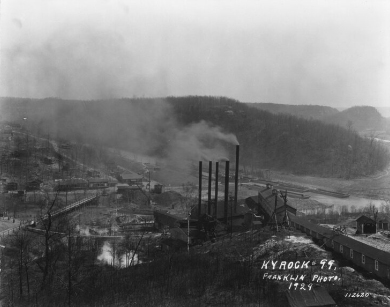
Rock asphalt can be found worldwide, but it is believed by many that nowhere else can it be found in such abundance as in Kentucky. While also found in Grayson, Hardin, Breckinridge, Logan and Warren Counties, Edmonson County has the most significant deposit. Mined at the Indian Creek Quarry, it had such an economic impact that a thriving company town called Kyrock was built by the Kentucky Rock Asphalt Company to support its production.
The discovery of KRA led to a sort of gold rush, with the worldwide demand for rock asphalt surging. For decades, the city of Kyrock thrived and the Kentucky Rock Asphalt Company became the leader of global rock asphalt production. The town provided activity, jobs, housing and a sense of purpose provided by the company. Some called it the “Wild West” of asphalt, with many rushing in for a share of the prosperity that showed no sign of ending.
But all things must end, at least for a while. As the demand for rock asphalt waned due to the less expensive and more consistent refined asphalt, so too did the prosperity of Kyrock. The Kentucky Rock Asphalt Company, once the world’s leading producer, closed its doors in 1957, leaving behind a legacy that is as much a part of Kentucky’s history as its bourbon and thoroughbred horses. The town of Kyrock, once thriving, is now a reminder of the nature of resource-based economies. Each prospers and wanes with demand.
Today, Kyrock isn’t really a ghost town – its people were adopted by Sweeden, the adjacent town. There is not much left of Kyrock aside from old road signs, churches and the Kyrock elementary school, which is still in operation.
Finding Indian Creek
A visit to a hardware store in Sweeden helped me locate the closed Indian Creek Quarry where the fortune of Kyrock was mined. A young person at the register had no idea what or where it was and after a shrug, pointed to an older couple who might be of help – and they sure were! “Drive past the church on the hill and you’ll see a big rock with a white sign beside it with nothing on it. There’s a gravel road that goes over the hill to the quarry.”
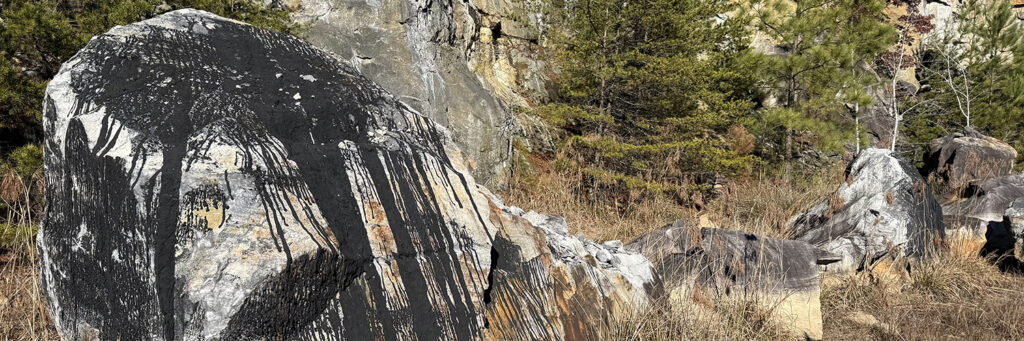
I found the rock and the blank white sign and drove nervously down a narrow gravel road into the woods. As I drove slowly through tall weeds, I passed huge sandstone boulders placed roughly every ten feet along either side of the old access road, some marked with black drips (bingo!).
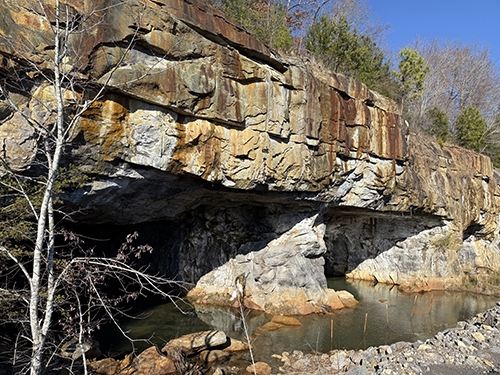
I continued on foot into the Indian Creek Quarry. That’s when I stopped and it hit me – bitumen was literally weeping from the cliff walls and underfoot was pure Kentucky rock asphalt. This is when I found myself understanding that my career in the petroleum industry was not only awesome…it was natural. I walked past the tunnels of the quarry imagining how impactful this discovery must have been for the indigenous people of the area long ago and historically worldwide.
As I walked, no one else around, I imagined the Kyrock community saying, “We may be quiet now, but we once ruled the world.”
Back at the lab
I gathered a few bitumen-streaked rocks and brought them to the laboratory. What we found was fascinating – we sliced through the largest rock (weighing 37 lbs. or 17 kg) and found a consistent charcoal gray color with a few slightly darker striations inside. The outside of the stone is much lighter where the bitumen has weathered away, exposing white silica sand, which accounts for approximately 85-95 percent of the total weight. This contrasts with black streaks of bitumen that seeped out and ran down over time. The underside, as found, is covered in a thick layer of bitumen originating from within the rock which had securely adhered it to the ground. We plan an extraction, followed by rheological testing on the recovered bitumen, if for no other reason, to satisfy our curiosity.
A place in the future
A conversation with William R. Florman, Senior Vice President of Reynolds Raw Materials and member of the Reynolds family (controllers of 60,000 acres of mineral and mining deeds), revealed ongoing international research aimed at the possibility of resuming production of Kentucky rock asphalt.
It should be noted that the University of Kentucky Transportation Center (KTC) has conducted a great deal of research with the focus on redeveloping Kentucky rock asphalt (KRA) for modern use. Some of the challenges addressed have been:
• Scaling/raveling – Flaking and wearing away of surface particles, creating a rough texture
• Stability – Fresh KRA mixtures had low structural strength
• Moisture sensitivity- Trapped water caused internal damage and premature failure
• Freeze-thaw damage
• Fatigue cracking
From its ancient origins to the history of its impact on lives in south central Kentucky, to potential modern-day applications, KRA reminds us of Earth’s amazing ability to create resources that benefit us.
Beavin is the Asphalt Institute Technical Training Coordinator.
Natural asphalt/bitumen in human history
70,000 years ago
It is speculated that a band of neanderthals brought down a mastodon with spear tips hafted to shafts with bitumen. This bitumen is credited with advancing paleolithic societies, allowing for better tool control and function, leading to major cognitive and practical advancements.
8,000 years ago
Neolithic farmers ferried vessels of mead to market with boats waterproofed by bitumen. Waterproofing was the most common use of bitumen prior to the construction of modern roads.
7,000 years ago
It is believed that an aboriginal group in Kentucky repaired canoes with it and used it to attach arrow points, salve wounds and paint cave walls. They noticed a salty taste, suggesting potential culinary uses.(Unverified. As much as we love asphalt, we do NOT suggest eating it.)
4,000 years ago
The Hebrew word for bitumen or asphalt is “chemar”, which translates to English as “slime”. It was used in the construction of the Tower of Babel according to the Bible in Genesis 11:3. (Asphalt Institute would like to thank anyone involved with discontinuing the use of ‘slime’ as another word for asphalt.)
3,500 years ago
At the peak of the practice, Egyptian mummies were preserved using bitumen. Its black color was associated with Osiris, God of the underworld and rebirth-regeneration.
88 years ago
The Brickyard (Indianapolis Motor Speedway) was partially paved with “Kyrock” for the 1937 Indianapolis 500. This is the first pavement over the 2.5 miles of brick racetrack. It was chosen for its excellent skid resistance, due to the highly angular silica sand content.
68 years ago
The Kentucky Rock Asphalt Company closes its doors. The rise of modern refineries provides a more consistent product with more predictable performance.